


Nessun prodotto nel carrello.
Cristalli
How to distinguish Fake & Real Crystal?

08
Mag
Mag
Real crystals are crystal clear and transparent. They have been used as decorative items by people for a long time and have become an integral part of daily life. Nowadays, we purchase crystals not only for decoration purposes, but also because of their powerful healing properties.
However, the crystals you see on the market are not all genuine. Even though they may look beautiful and attractive. It’s precisely their lifelike appearance that leads so many consumers to throw their money away. Don’t be deceived by the fake crystals any longer.
In this article, I will offer my personal views on several methods to distinguish genuine crystals from imitations.
Common crystal imitations
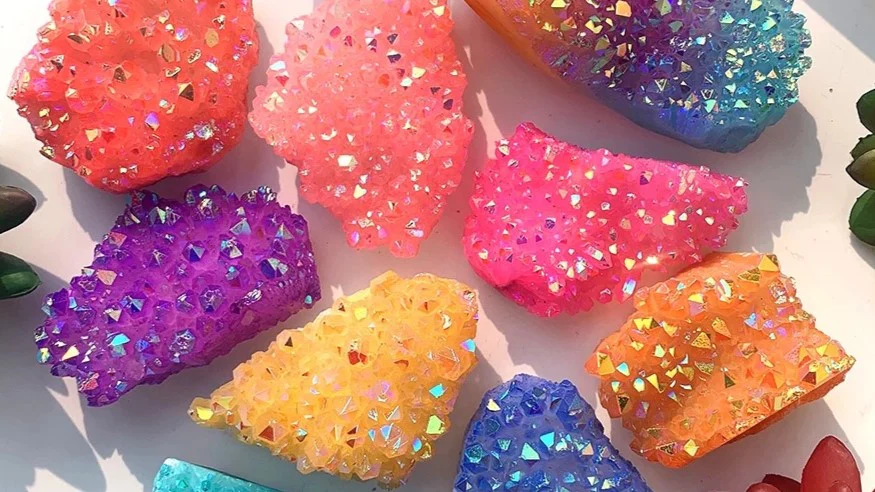
It goes without saying that artificial crystal is much cheaper than real crystal. In order to make these low-cost artificial crystals difficult to detect, some processing is usually required to make them almost indistinguishable from real crystal in appearance.
In terms of technical feasibility or manufacturing difficulty, the fake crystals available on the market are usually made of glass, plastic, crystal glass, etc.
Vetro
Glass is clear and transparent, without any texture. This kind of crystal is deliberately imitated to resemble the colors of real crystals such as amethyst, rose quartz, etc., and is thus mixed in with genuine crystals. The interior often contains small bubbles, so many people use these bubbles as a way to distinguish it from real crystal.
Plastic
Plastic is very lightweight. If it is used to imitate large crystals, it can be easily identified. Therefore, usually this material is made into smaller crystal replicas, such as earrings and rings, to deceive people. Moreover, the texture and hardness of plastic replicas can be easily distinguished from genuine crystals compared to other imitation materials.
Lead glass
Lead glass is a type of glass formed after the melting of lead-containing metals. It looks very nice and is capable of giving a very clear and bright effect, so it is definitely a good idea to use it as decorative pieces. However, different from real crystal, it does not have any spiritual effects. Below are 10 ways to help you tell between real and fake crystals.
10 Tips to Distinguish between Real and Fake Crystals

1. Durezza
Real crystals are not easily scratched because they have a high degree of crystal hardness. And imitation fake crystals made of glass or plastic are prone to being scratched. You can try gently scraping the jewelry with small stones. If there are obvious scratches, your crystal might be a fake imitation made of glass or the like.
2. Peso
The densities of different substances are different, genuine crystal is usually heavier than fake crystal due to it. You can simply hold them in your hands and feel the difference in weight. Natural crystals are relatively heavy, while plastic glasses and other materials are light and airy. People who have long been in contact with crystals can easily distinguish them.
3. Transparency
Real crystals usually require a long period of growth and a specific formation environment. Natural crystals grow under natural conditions, are inevitably affected by external factors, and thus may contain some impurities. If your crystal is too perfect and has no flaws at all, then it is very likely to be fake.
4. Sound
When two pieces of crystal are gently bumped against each other or lightly tapped with fingers, the real crystal produces a quite sharp, pure sound with very short echoing. Yet, the sound coming from the glass, plastic, and other imitation materials is less clear and has a very different tone quality.
5. Bubble
Both natural crystals and glass imitations have bubbles. However, the difference lies in the fact that the bubbles in natural crystals are irregular and few, and they are very difficult to be observed with the naked eye. The bubbles in the glass are numerous and of uniform size, which can be clearly observed with the naked eye.
6. Lighting effect
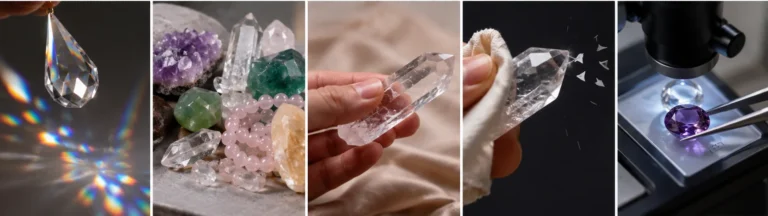
After being exposed to light, real crystal will refract a soft and natural glow, which is not overly dazzling. However, the luster of counterfeit products is harsh and will appear dazzling and unnatural under strong light. The luster of lead glass is similar to that of natural crystals, but it is not as smooth and gentle.
7. Price
The formation of genuine crystals takes a long time and is not easy to obtain, so their prices will not be extremely low. A crystal that looks extremely “perfect” but whose price is much lower than the market rate – you must be on your guard. It is very likely to be a counterfeit.
8. Tactile impression
Just by touching the crystal with your hand, you will be able to notice a cooling effect, and it will be lasting for some time. If the chill is very faint, or you don’t feel it at all or only for a moment, then it is fake.
9. Friction static electricity
Natural crystals have a certain piezoelectric effect. After being rubbed, they will generate a slight static electricity. However, counterfeit products (glass, plastic) are difficult to produce static electricity, or the generated static electricity is very weak.
The simplest method is to place the crystal close to fine and lightweight items such as paper scraps and hair strands. If the crystal can attract the paper scraps and hair strands, it indicates that it has generated static electricity, and it is more likely to be a real crystal; if it can hardly attract or shows no reaction at all, it is likely to be a counterfeit. But it is recommended to operate in a dry environment.
10. Professional testing
If the crystal is of high value, it is recommended to use professional detection methods. For example, observe the internal structure of the crystal with a magnifying glass, test the refractive index of the crystal with a refractometer, and use a polarizing microscope for detection, etc. Of course, if the budget is sufficient, sending the crystal to a professional jewelry testing institution for authoritative testing is also an effective method.
Which crystals are often faked?
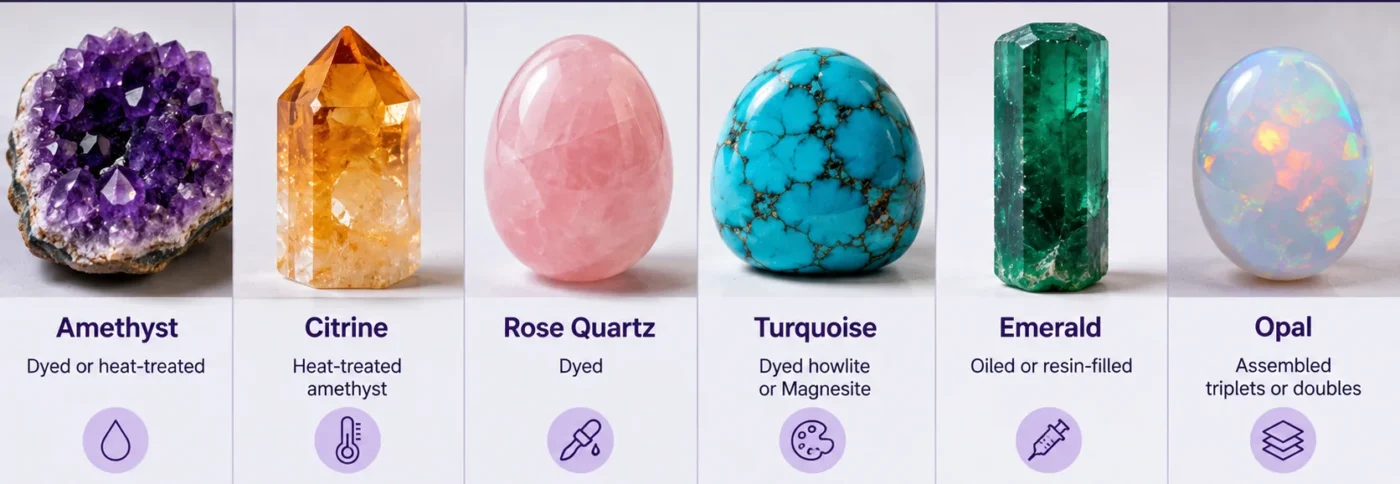
Not all crystals are easily counterfeited. Generally speaking, crystals with common colors, ordinary appearance, and reasonable prices are more likely to be targeted for counterfeiting by merchants.
Since the counterfeiting of crystals is quite difficult and costly because of the rare and special colors of some crystal varieties, they are generally not counterfeited. However, crystals such as clear quartz, Ametista, citrine, and rose quartz, which are more common and have easily replicable colors, are more likely to be counterfeited.
Where do I find legitimate crystals to buy?
Nacrystal provide natural, real crystals and crystal products, including common amethyst and precious topaz. We allow the customer real photos and videos before the order, and also offer a 30-day refund service. Customer satisfaction has always been our main focus and we have been continuously providing professional and affordable crystal wholesale services for years.